Thailand tourism update – April 2026
ASIA DMC
Key trends shaping the market for travel professionals
Thailand’s tourism sector continues to demonstrate strong recovery momentum, while entering a new phase of strategic adjustment. For travel professionals, especially in the B2B segment, understanding these shifts is essential to stay competitive and aligned with market demand.
How ASIA DMC supports your growth in Thailand
At ASIA DMC, we help our partners stay ahead of market changes by:
- Designing customized, experience-driven itineraries
- Optimizing programs for value and operational efficiency
- Providing on-the-ground insights and real-time updates
- Supporting both B2B series and tailor-made travel solutions
1. Policy changes: Shorter Visa-free stay under consideration
Thai authorities are currently reviewing a proposal to reduce the visa-free stay period from 60 days to 30 days.
This move is primarily aimed at:
- Strengthening immigration control
- Preventing misuse of long-term stays
- Enhancing overall travel security
Impact on B2B:
Shorter stays may accelerate demand for compact, high-quality itineraries, particularly for long-haul markets.

2. Strong performance with emerging headwinds
Thailand welcomed over 25 million international visitors between January and October 2025, generating approximately THB 1.15 trillion in tourism revenue.
However, projections for 2026 are being revised due to:
- Geopolitical tensions (notably in the Middle East)
- Reduced arrivals from certain long-haul markets
Impact on B2B:
While demand remains strong, market diversification and flexible pricing strategies will be critical.

3. Songkran 2026: A High-impact travel driver
The 2026 Songkran Festival once again proved its strength as a major tourism catalyst, with nearly 5 million participants in Bangkok alone.
Impact on B2B:
Seasonal events like Songkran present strong opportunities for:
- Group travel
- Incentive programs
- Experience-led itineraries

4. Strategic focus: sustainability and premium travel
The Tourism Authority of Thailand (TAT) is actively repositioning the country through:
- “Soft power” campaigns, including collaborations with global figures like Lisa
- Promotion of luxury experiences, such as the Royal Blossom train
- A stronger emphasis on sustainable and responsible tourism
Impact on B2B:
Thailand is shifting from volume-driven growth to a value-driven tourism model.

5. Infrastructure & Operational Pressures
Airports across Thailand continue to handle high passenger volumes, with up to 3.7 million passengers expected during peak periods.
At the same time, industry stakeholders are raising concerns about:
- A strong Thai baht, impacting price competitiveness
- Rising airfares, affecting travel decisions
Impact on B2B:
Cost sensitivity is increasing, requiring better packaging and value engineering.

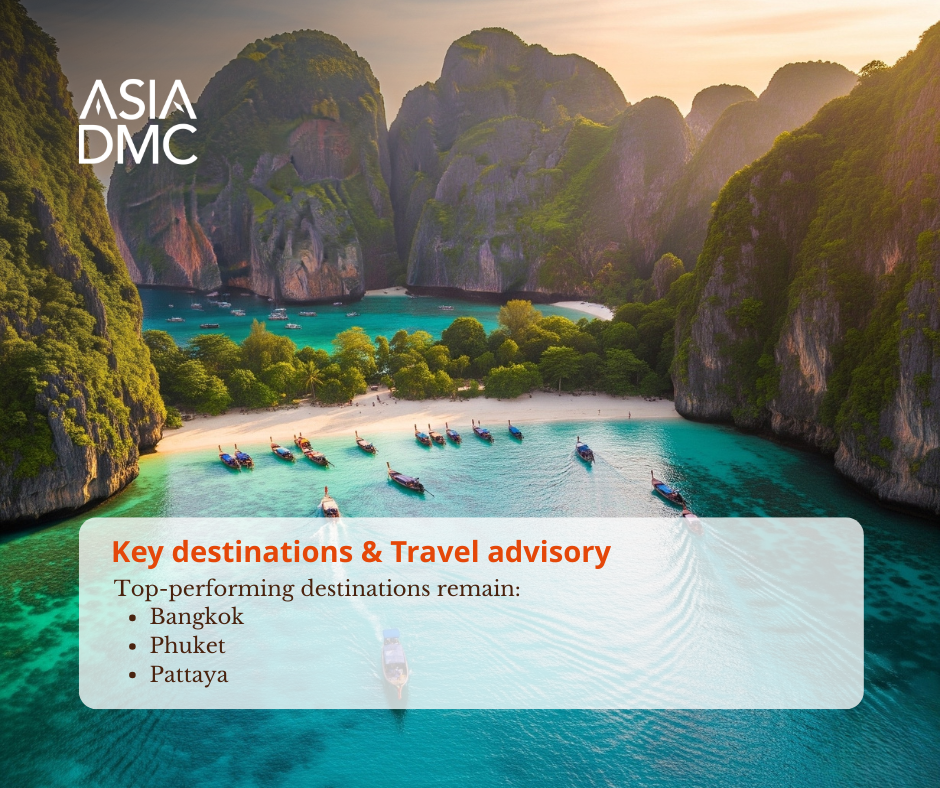
6. Key Destinations & Travel Advisory
Thailand’s top-performing destinations remain:
- Bangkok
- Phuket
- Pattaya
At the same time, travel advisories recommend caution in:
- Areas within 10 km of the Thailand–Cambodia border
- Certain southern border provinces
What This Means for B2B Travel Partners
For travel agents and tour operators, success in 2026 will depend on the ability to:
- Design shorter, high-impact itineraries
- Focus on premium and experience-led products
- Adapt pricing strategies amid currency and airfare pressures
- Diversify source markets to reduce risk
Ready to adapt your Thailand programs?
Connect with ASIA DMC to explore smarter, more competitive travel solutions tailored to today’s evolving market.
 1
1